OATS vs. SAC: How to Choose the Right Site for Radiated Emissions Testing
Struggling with OATS ambient noise? Compare Open Area Test Sites vs. Semi-Anechoic Chambers. Learn how SACs meet NSA limits for CISPR/ANSI EMC compliance.
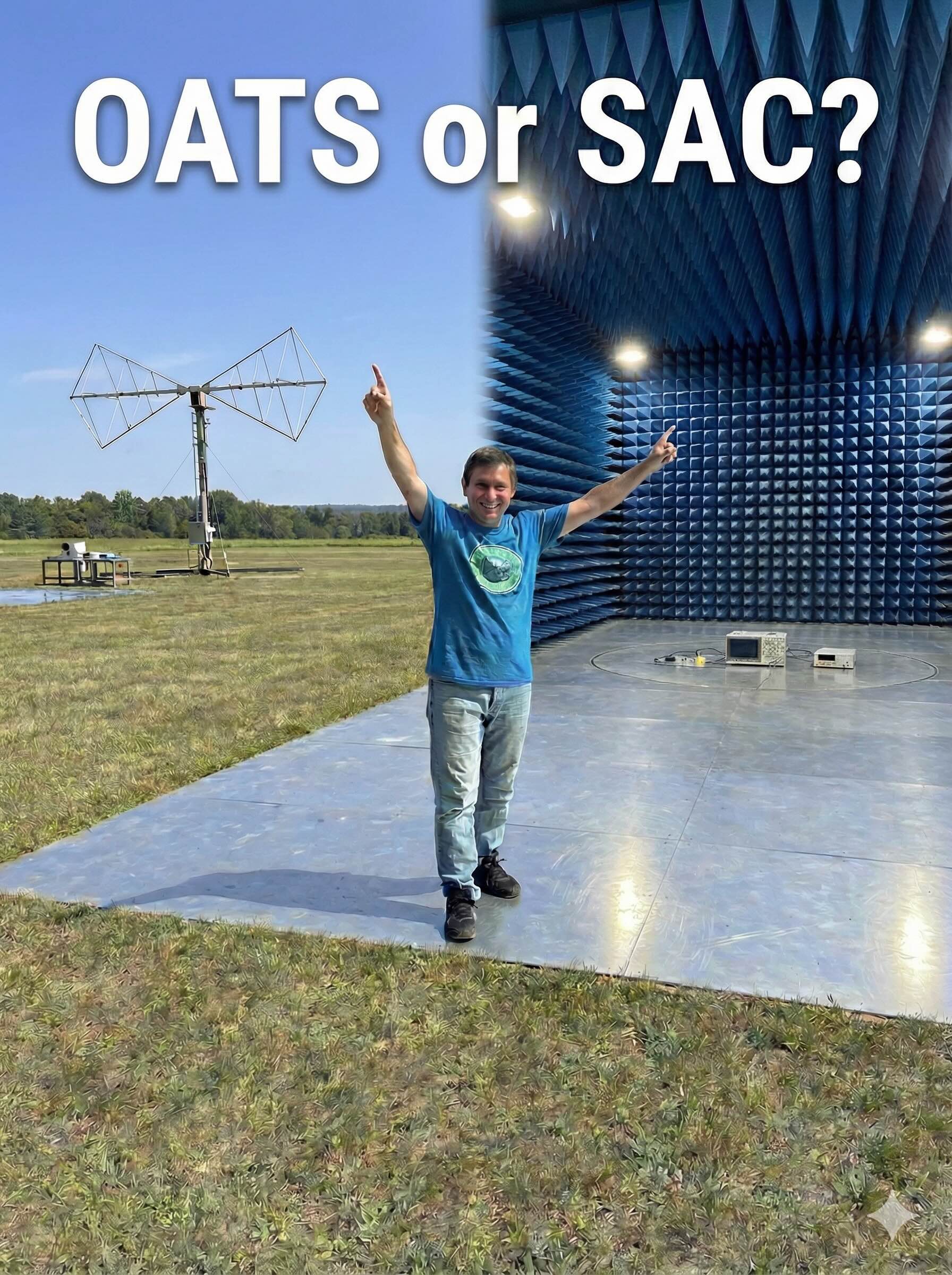
What Are OATS and SAC in EMC Testing?
Radiated emissions testing is a cornerstone of electromagnetic compatibility (EMC) compliance. Every electronic product — from consumer electronics to industrial equipment — must demonstrate that its unintentional RF emissions remain below regulatory limits. The test environment where these measurements take place directly determines data quality, and two site types dominate the industry: the Open Area Test Site (OATS) and the Semi-Anechoic Chamber (SAC).
Understanding the strengths and limitations of each environment helps lab managers, compliance engineers, and product developers select the right facility for their testing needs.
How Does an Open Area Test Site Work?
An OATS recreates ideal electromagnetic free-space conditions above a conductive ground plane. With no walls or ceiling to generate reflections, the only signal paths between the Equipment Under Test (EUT) and the receiving antenna are the direct path and a single ground-plane reflection — exactly the geometry described in theoretical propagation models.
Advantages of OATS
- Theoretical purity: The two-ray propagation model (direct + ground reflection) is the foundational reference for radiated emissions standards.
- Lower initial investment: Building an outdoor ground plane costs less than constructing a shielded, absorber-lined room.
- Large EUT capacity: Open-air geometry allows testing of oversized equipment without chamber-size constraints.
Challenges Engineers Face with OATS
The modern electromagnetic environment presents significant practical hurdles for outdoor testing:
- Ambient RF interference: Cellular networks (LTE, 5G), FM broadcast (88 — 108 MHz), digital television, Wi-Fi, and other wireless services create a high noise floor that can mask EUT emissions.
- Weather sensitivity: Rain, snow, wind, and temperature swings affect measurement repeatability and can damage sensitive equipment.
- Mandatory ambient scans: Engineers must perform background-noise measurements before each test session, adding time and complexity to every campaign.
- Limited operating hours: Many jurisdictions restrict outdoor testing to specific times, reducing lab throughput.
- Security concerns: Open-air setups expose pre-release products to public view.
How Does a Semi-Anechoic Chamber Work?
A Semi-Anechoic Chamber brings the OATS concept indoors by surrounding the test volume with a Faraday cage (welded-steel or modular-panel shielding) and lining the walls and ceiling with RF absorber materials — typically a combination of ferrite tiles for lower frequencies and carbon-loaded polyurethane foam pyramids for higher frequencies. The metallic floor is left bare to preserve the ground-plane reflection that the OATS model requires.
Why Labs Prefer Semi-Anechoic Chambers
- Zero ambient noise: The shielding enclosure blocks external RF signals, producing a clean measurement environment where even low-level EUT emissions are visible.
- All-weather operation: Climate-controlled interiors eliminate weather-related delays and data variability.
- High repeatability: Stable environmental conditions and fixed absorber geometry deliver consistent results across test sessions.
- 24/7 availability: No outdoor-noise curfews or daylight constraints.
- Confidentiality: Solid walls prevent visual and electromagnetic eavesdropping on unreleased products.
Normalized Site Attenuation: The Bridge Between OATS and SAC
For a Semi-Anechoic Chamber to produce results equivalent to an OATS, it must pass a Normalized Site Attenuation (NSA) validation. Standards CISPR 16-1-4 and ANSI C63.4 define the procedure: the measured NSA of the chamber must fall within plus or minus 4 dB of the theoretical OATS value across the required frequency range.
Meeting this criterion ensures that emissions data collected inside the SAC can be directly compared with OATS reference levels and regulatory limits — giving engineers confidence that a passing result in the chamber means a passing result in any accredited facility worldwide.
OATS vs. SAC: Side-by-Side Comparison
| Feature | Open Area Test Site (OATS) | Semi-Anechoic Chamber (SAC) |
|---|---|---|
| Ambient Noise | High — FM, TV, cellular signals present | Negligible — shielded from external RF |
| Weather Dependency | High — rain, wind, temperature affect data | None — climate-controlled environment |
| Measurement Repeatability | Moderate — ambient conditions fluctuate | High — stable and controlled |
| Initial Investment | Lower CAPEX for ground plane | Higher CAPEX for shielding and absorbers |
| Operational Cost | Higher per-test (ambient scans, rescheduling) | Lower per-test (no weather delays) |
| Product Security | Low — open to public observation | High — enclosed and private |
| Throughput | Limited by weather and ambient windows | Continuous — operates around the clock |
| Test Distance Options | 3 m, 10 m, 30 m readily achievable | Typically 3 m or 10 m (chamber-size dependent) |
Which Environment Should You Choose?
Pre-Compliance and Troubleshooting
For debug and pre-compliance work, a SAC is the clear winner. The quiet electromagnetic background lets engineers identify emission peaks just a few dB above the noise floor — spikes that would be completely invisible on an OATS. Fast turnaround and repeatable conditions accelerate the design-fix-retest cycle.
Full Compliance and Certification
While some EMC standards still recognize OATS measurements, the global market has moved decisively toward 3-meter and 10-meter SACs for formal compliance testing. Accreditation bodies, OEMs, and test houses increasingly rely on chambers because of their superior data integrity, year-round availability, and lower long-term operating costs.
When an OATS Still Makes Sense
Large-scale systems — such as vehicle-level automotive tests, wind turbines, or heavy industrial machinery — may exceed the physical dimensions of available chambers. In these scenarios, a properly maintained OATS (or a purpose-built large SAC) remains the only viable option.
Frequently Asked Questions
Can SAC results be used interchangeably with OATS results?
Yes, provided the SAC passes NSA validation per CISPR 16-1-4 or ANSI C63.4. A validated chamber produces measurement uncertainty comparable to a compliant OATS.
What frequency range does radiated emissions testing cover?
Most commercial standards (CISPR 32, FCC Part 15, EN 55032) require measurements from 30 MHz to 1 GHz, with some extending to 6 GHz or 40 GHz for specific product categories.
How much does a Semi-Anechoic Chamber cost?
Costs vary widely based on test distance, shielding performance, and absorber specification. A 3-meter SAC suitable for commercial product testing typically ranges from approximately 100,000 to 500,000 USD, while a 10-meter fully compliant chamber can exceed 1 million USD.
Do I need both an OATS and a SAC?
Most modern laboratories operate exclusively with SACs. An OATS may complement a chamber-based lab when oversized EUTs must be tested or when a standard explicitly requires outdoor measurements.
How TESTUPS Can Help
TESTUPS designs, builds, and validates Semi-Anechoic Chambers and complete EMC test systems worldwide. From compact 3-meter pre-compliance rooms to full-size 10-meter accreditation-grade facilities, our turn-key solutions include chamber construction, absorber installation, antenna systems, test instrumentation, and NSA site validation — so your lab is measurement-ready from day one.