ECE R10 Countries — Complete List of E-Mark Signatory Nations
Complete list of countries accepting ECE R10 E-mark certification under the UNECE 1958 Agreement, including country codes, mutual recognition rules, and certification guidance.
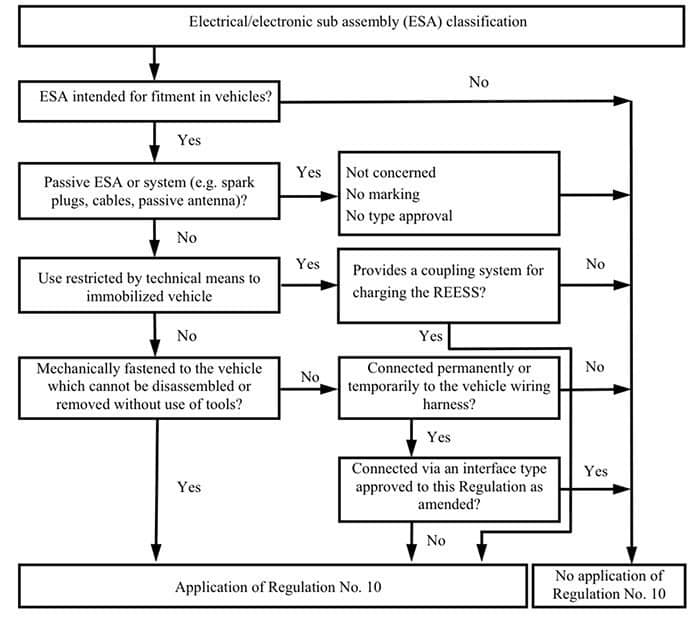
Introduction to ECE R10 E-Mark Certification
ECE R10 is the UNECE regulation governing the electromagnetic compatibility (EMC) of vehicles and electronic sub-assemblies (ESAs). When a product receives type approval under ECE R10, it is granted an E-mark, which signifies that it meets the EMC requirements established by the regulation. This E-mark is recognized by all contracting parties to the 1958 Agreement on the Adoption of Harmonized Technical Prescriptions for Wheeled Vehicles.
Understanding which countries accept E-mark certification is essential for automotive manufacturers and suppliers planning to export vehicles or components internationally. The E-marking system provides a framework for mutual recognition, meaning a product approved in one contracting party country is accepted in all other contracting party countries without additional testing.
The 1958 Agreement — Foundation of E-Mark Recognition
The Agreement Concerning the Adoption of Harmonized Technical United Nations Prescriptions for Wheeled Vehicles, Equipment and Parts (commonly known as the 1958 Agreement), establishes the legal framework for mutual recognition of type approvals. Countries that have acceded to this agreement and specifically apply Regulation No. 10 will accept ECE R10 type approvals granted by any other contracting party.
Key principles of the 1958 Agreement include:
- Mutual recognition: A type approval granted by one contracting party must be accepted by all other contracting parties that apply the same regulation.
- Single approval: Manufacturers need only obtain one E-mark approval from any contracting party to access all participating markets.
- Technical service designation: Each contracting party designates technical services (test laboratories) authorized to conduct testing on its behalf.
- Type approval authority: Each country has a designated government body responsible for granting and administering type approvals.
Complete List of ECE R10 Contracting Party Countries
The following table lists the contracting parties to the 1958 Agreement with their assigned E-mark country codes. Note that not all contracting parties apply every UNECE regulation. The countries listed below have adopted Regulation No. 10 for vehicle and/or ESA EMC type approval.
| E-Mark Code | Country | E-Mark Code | Country |
|---|---|---|---|
| E1 | Germany | E2 | France |
| E3 | Italy | E4 | Netherlands |
| E5 | Sweden | E6 | Belgium |
| E7 | Hungary | E8 | Czech Republic |
| E9 | Spain | E10 | Serbia |
| E11 | United Kingdom | E12 | Austria |
| E13 | Luxembourg | E14 | Switzerland |
| E16 | Norway | E17 | Finland |
| E18 | Denmark | E19 | Romania |
| E20 | Poland | E21 | Portugal |
| E22 | Russian Federation | E23 | Greece |
| E24 | Ireland | E25 | Croatia |
| E26 | Slovenia | E27 | Slovakia |
| E28 | Belarus | E29 | Estonia |
| E31 | Bosnia and Herzegovina | E32 | Latvia |
| E34 | Bulgaria | E36 | Lithuania |
| E37 | Turkey | E39 | Azerbaijan |
| E40 | North Macedonia | E42 | European Union |
| E43 | Japan | E45 | Australia |
| E46 | Ukraine | E47 | South Africa |
| E48 | New Zealand | E49 | Cyprus |
| E50 | Malta | E51 | Republic of Korea |
| E52 | Malaysia | E53 | Thailand |
| E54 | Albania | E55 | Montenegro |
| E56 | Moldova | E57 | Algeria |
| E58 | Tunisia | E59 | Georgia |
| E60 | Armenia | E62 | Egypt |
Note: E-mark codes E15, E30, E33, E35, E38, E41, E44, and E61 are either reserved, not yet assigned, or belong to countries that have not adopted Regulation No. 10. Always verify current adoption status with the relevant type approval authority before beginning the certification process.
How E-Mark Country Codes Work
Each E-mark carries a code identifying the country that granted the type approval. The E-mark format for ECE R10 appears as:
- A circle containing the letter “E” followed by the country code number.
- The regulation number (10) and revision suffix.
- The type approval number assigned by the granting authority.
For example, an E-mark granted by Germany would display E1 within the circle, followed by the approval reference. This marking must be permanently affixed to the product or its packaging as specified in the regulation.
Regional Considerations
European Union
All EU member states accept ECE R10 type approvals. In addition, the EU (represented by code E42) can itself grant type approvals. EU member states also maintain their individual type approval authority capabilities. Vehicles and ESAs destined for the EU market must hold valid ECE R10 approval before they can be registered or sold.
Asia-Pacific
Japan (E43), Australia (E45), Republic of Korea (E51), Malaysia (E52), and Thailand (E53) are key Asia-Pacific contracting parties. Manufacturers targeting these markets benefit from the mutual recognition provisions, though some countries may impose additional national requirements beyond the ECE regulation.
Other Markets
Countries not party to the 1958 Agreement, such as the United States, Canada, China, India, and Brazil, maintain their own separate EMC regulatory frameworks. Products destined for these markets require compliance with local regulations (for example, FCC Part 15 in the United States) in addition to any ECE R10 approval.
Steps to Obtain ECE R10 Certification
- Select a type approval authority: Choose any contracting party country as the granting authority. The choice is typically based on the manufacturer’s location, existing business relationships, or the speed and cost of the approval process.
- Engage an accredited test laboratory: Testing must be conducted by a technical service recognized by the chosen type approval authority.
- Prepare test samples and documentation: Provide the vehicle or ESA along with technical documentation including circuit descriptions, operating modes, and installation instructions.
- Conduct EMC testing: Complete the full set of emission and immunity tests required by ECE R10 for the relevant category (vehicle or ESA).
- Submit results for approval: The test laboratory issues a test report, which is submitted to the type approval authority for review and granting of the E-mark.
- Apply the E-mark: Once approved, the manufacturer applies the E-mark to products and maintains compliance through production conformity procedures.
How TESTUPS Can Help
TESTUPS is an accredited testing partner experienced in ECE R10 type approval testing across all revisions, including the latest Revision 7. We work with type approval authorities in multiple contracting party countries and can guide manufacturers through the entire certification process, from test planning to E-mark issuance. Our facilities support both vehicle-level and ESA-level testing with fast turnaround times.
Contact TESTUPS to begin your ECE R10 E-mark certification project.
Need Expert EMC Assistance?
TESTUPS provides complete EMC solutions — from test equipment and anechoic chambers to certification services. Contact our team for tailored support.