TESTUPS · Automotive EMC Solutions
Vehicle EMC Anechoic Chambers
Turnkey EMC test chambers for the automotive industry — engineered for full electromagnetic-compatibility type-approval per UN ECE Regulation No. 10 (Revision 7), CISPR 12 / 25 / 36, the ISO 11451 / 11452 series, ISO 7637, ISO 10605, and major OEM specifications. Two product variants cover the full vehicle envelope, from motorcycles and passenger cars to articulated buses, heavy trucks, and agricultural tractors.
Two chamber variants
TESTUPS engineers vehicle EMC chambers in two standard footprints, each sized around the vehicle category being tested. Both variants use the same shielding architecture, absorber treatment, and instrumentation philosophy — the difference is the test volume and the handling equipment for the vehicle under test (VUT).
Variant 1
Regular Vehicle EMC Chamber
Sized for passenger cars and light commercial vehicles. Accommodates the M1 (passenger cars, ≤ 8 seats), N1 (light commercial ≤ 3.5 t), the full L category (motorcycles, mopeds, tricycles, light quadricycles), and small O1 / O2 trailers.
- · Single-axle chassis dynamometer or roller bench
- · Antenna geometries for CISPR 25 component + R10 vehicle-level
- · Typical clear span suited to vehicles up to ~6 m length
- · Integrated turntable for azimuthal pattern measurement
Variant 2
Long Vehicle EMC Chamber
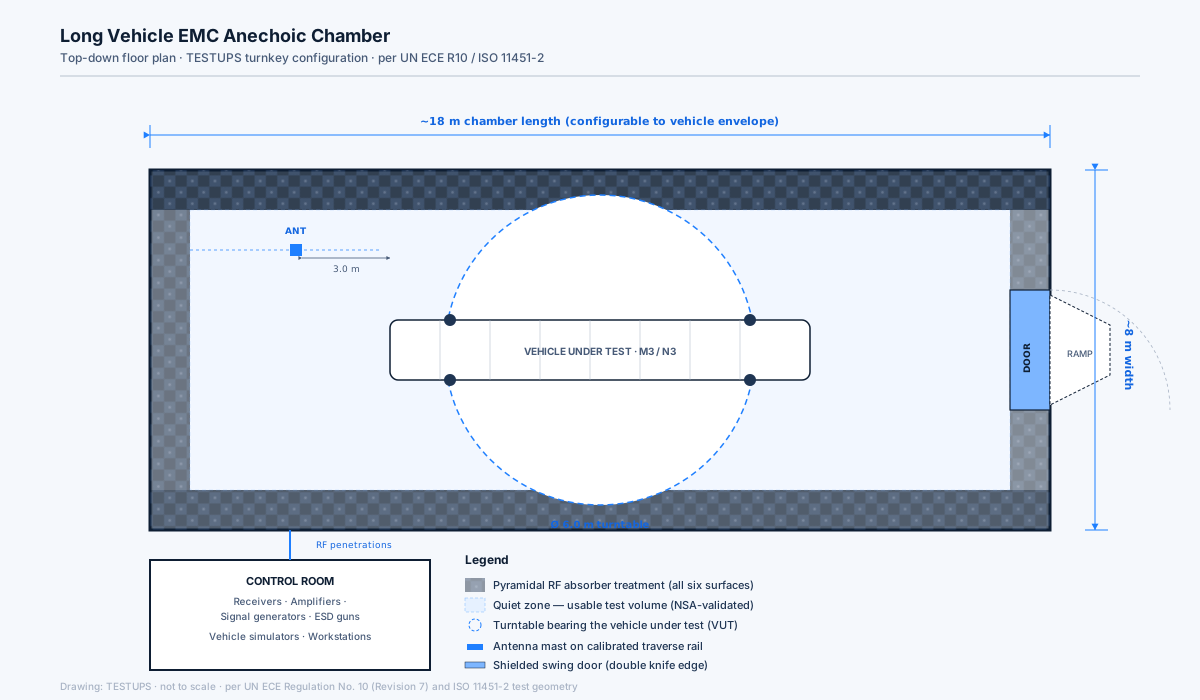
Engineered for the heavy and long end of the fleet. Accommodates M3 (buses and coaches > 5 t — city buses, intercity coaches, articulated buses), N2 / N3 (medium and heavy trucks), O3 / O4 (heavy trailers and semi-trailers), and category T agricultural / forestry tractors with their R and S towed equipment.
- · Multi-axle dynamometer / roller bench, optionally sliding
- · Extended absorber-lined quiet zone along long-axis walls
- · Oversized swing or sliding door for vehicles 12 – 20+ m long
- · Reinforced ceiling support for elevated antenna positioning
Long Vehicle Chamber — simulation
Engineered for buses, trucks, and heavy trailers
The Long Vehicle EMC Chamber accommodates the largest road vehicles requiring type-approval: city buses and coaches (UN ECE category M3, typically 10 – 18 m), heavy trucks (N3, often 12 – 16 m as tractor-only and 16 – 25 m articulated), and agricultural tractors with their implements (T + R + S).
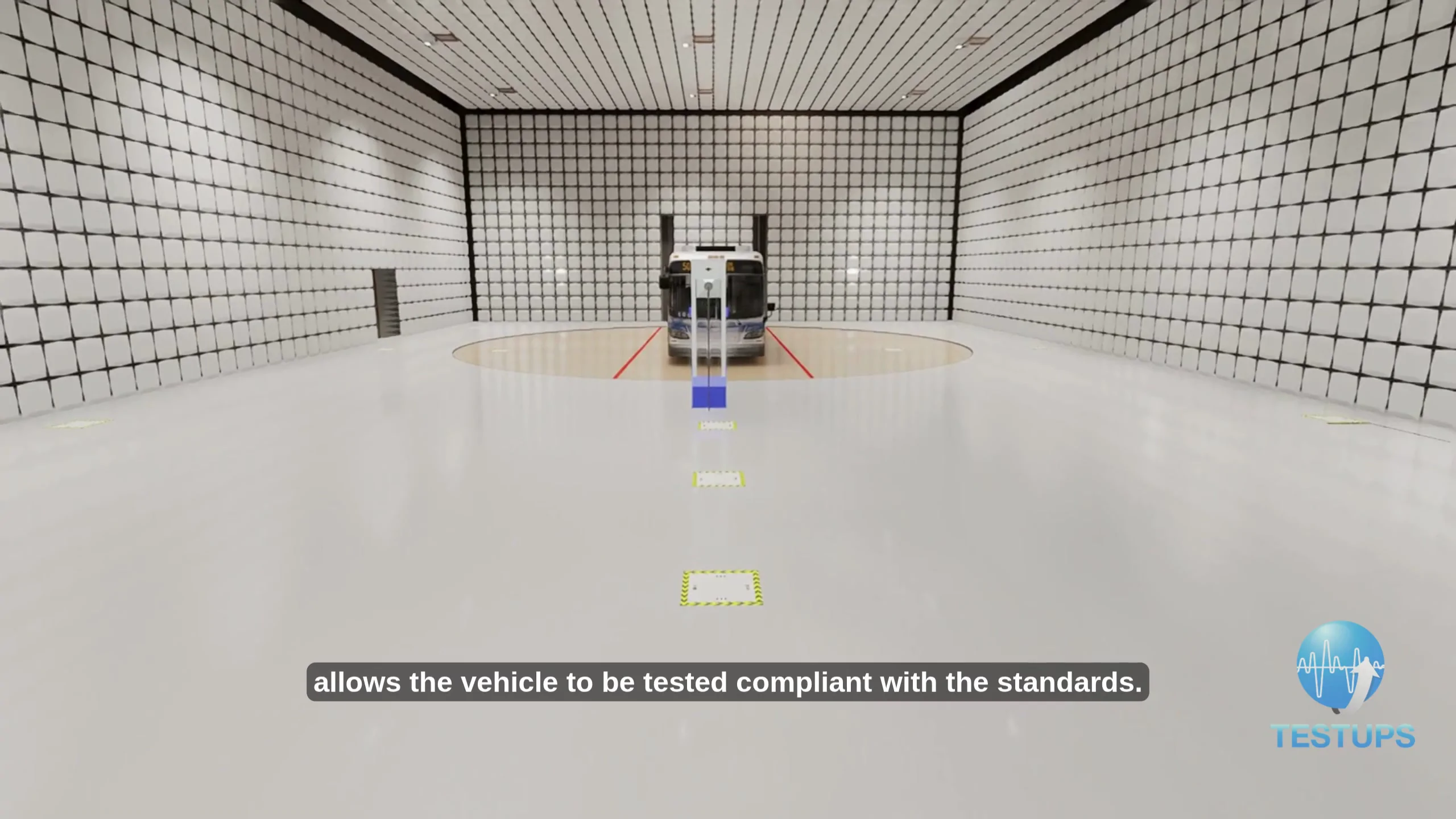
The video shows a TESTUPS simulation of a long-vehicle chamber installation — the shielded shell, RF absorbers across all six surfaces, sliding access door, embedded dynamometer, antenna mast on its azimuthal positioner, and the adjacent shielded control room housing receivers and amplifiers.
Each chamber is custom-sized to the heaviest vehicle the customer expects to type-approve over the chamber's 25-year service life — TESTUPS sizes the structure, dyno, door, and absorber zone around that envelope rather than against a stock catalogue.
Long Vehicle EMC Chamber — TESTUPS simulation video
Vehicle categories (UN ECE / EU)
The UN ECE / EU type-approval system classifies vehicles into categories L, M, N, O, T, R, and S. UN ECE Regulation No. 10 applies to all of them. The right column indicates which TESTUPS chamber variant accommodates each category.
| Category | Description | Chamber variant |
|---|---|---|
L1 | Two-wheel moped, max speed 45 km/h, engine ≤ 50 cm³ (or ≤ 4 kW electric) | Regular |
L2 | Three-wheel moped (same speed / engine limits as L1) | Regular |
L3 | Two-wheel motorcycle — speed > 45 km/h or engine > 50 cm³ | Regular |
L4 | Two-wheel motorcycle with sidecar | Regular |
L5 | Three-wheel motor vehicle (tricycle) | Regular |
L6 | Light quadricycle ≤ 350 kg, max speed 45 km/h | Regular |
L7 | Heavy quadricycle (e.g. side-by-side / UTV) | Regular |
M1 | Passenger car — ≤ 8 seats plus driver (sedan, hatchback, SUV, MPV) | Regular |
M2 | Bus / coach ≤ 5,000 kg gross — minibuses, small shuttle buses | Regular or Long |
M3 | Bus / coach > 5,000 kg gross — city buses, intercity coaches, articulated buses | Long |
N1 | Light commercial vehicle ≤ 3.5 t — vans, pickups, light delivery trucks | Regular |
N2 | Medium truck 3.5 – 12 t | Long |
N3 | Heavy truck > 12 t — semi-trailer tractors, rigid heavy trucks | Long |
O1 | Trailer ≤ 0.75 t | Regular |
O2 | Trailer 0.75 – 3.5 t | Regular |
O3 | Trailer 3.5 – 10 t | Long |
O4 | Trailer > 10 t — semi-trailers, drawbar trailers, dollies | Long |
T | Agricultural or forestry tractor (wheeled or tracked) | Long |
R | Trailer towed by a category T tractor | Long |
S | Interchangeable towed equipment (agricultural implements) | Long |
Reference: UN ECE Consolidated Resolution on the Construction of Vehicles (R.E.3), Annex 7, and EU Regulation (EU) 2018/858, Article 4.
Vehicle EMC standards covered
TESTUPS chambers are designed against the full body of standards that govern automotive electromagnetic compatibility — from the regulatory framework that grants type-approval, through the vehicle-level and component-level test methods, to the transient and ESD methods that complete the picture, and the OEM specifications that lay on top.
Regulatory / type-approval framework
- ▸ UN ECE Regulation No. 10, Revision 7 — uniform provisions concerning the approval of vehicles with regard to electromagnetic compatibility (the primary EMC type-approval reference)
- ▸ EU Directive 2014/30/EU — Electromagnetic Compatibility Directive (general EMC framework adopted into Member-State law)
- ▸ Regulation (EU) 2018/858 — type-approval and market surveillance of motor vehicles
- ▸ FCC Part 15 (Title 47 CFR) — radio-frequency emissions limits for the United States market
- ▸ Türkiye AİTM (Araçların İmal, Tadil ve Montajı Hakkında Yönetmelik) — adopts UN ECE R10 for the Turkish market
Vehicle-level test methods (whole-vehicle in the chamber)
- ▸ ISO 11451-1 — General principles and definitions for vehicle test methods
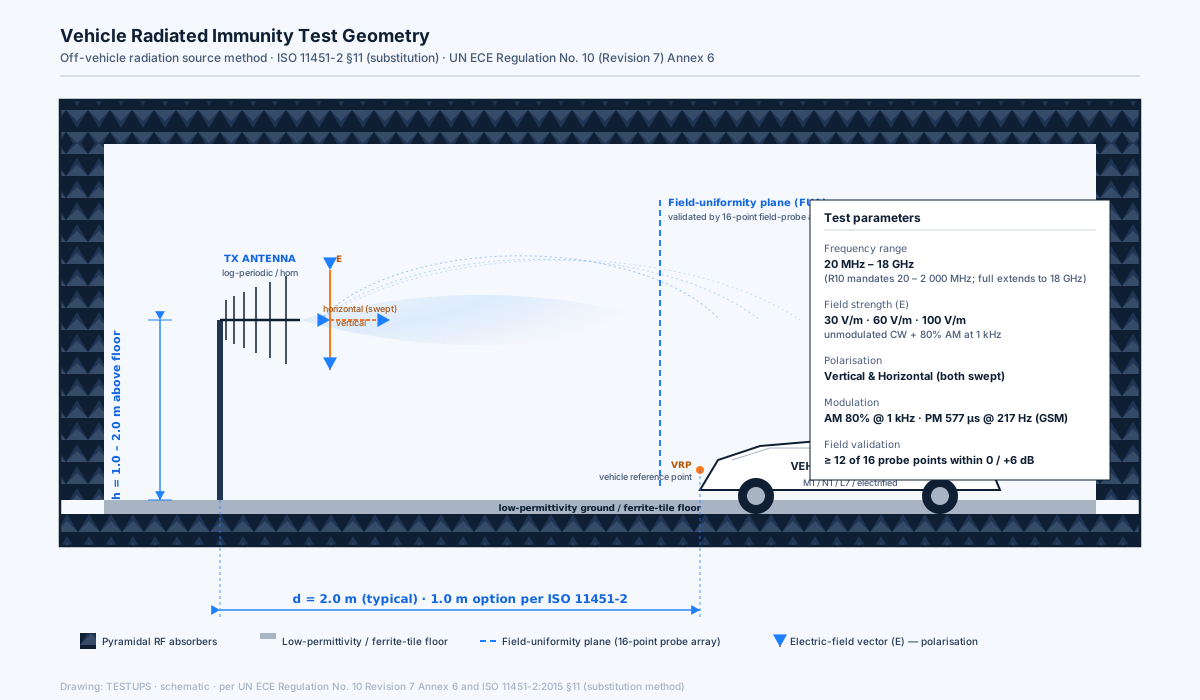
- ▸ ISO 11451-2 — Off-vehicle radiation sources (radiated immunity, the principal R10 vehicle test)
- ▸ ISO 11451-3 — On-board transmitter simulation
- ▸ ISO 11451-4 — Bulk Current Injection (BCI) at the vehicle level
- ▸ CISPR 12 — Radio disturbance characteristics for the protection of off-board receivers
- ▸ CISPR 36 — Electric and hybrid electric road vehicles, 9 kHz – 30 MHz, for protection of off-board receivers
Component / sub-system test methods
- ▸ ISO 11452-1 — General principles and definitions for component test methods
- ▸ ISO 11452-2 — Absorber-Lined Shielded Enclosure (ALSE) — radiated immunity at the component level
- ▸ ISO 11452-3 — TEM (Transverse Electromagnetic) cell
- ▸ ISO 11452-4 — Harness excitation methods (Bulk Current Injection)
- ▸ ISO 11452-5 — Stripline
- ▸ ISO 11452-7 — Direct RF power injection
- ▸ ISO 11452-8 — Magnetic field immunity
- ▸ ISO 11452-9 — Portable transmitter immunity
- ▸ ISO 11452-10 — Audio frequency immunity
- ▸ ISO 11452-11 — Reverberation chamber
- ▸ CISPR 25 — Radio disturbance characteristics for the protection of on-board receivers (component-level RE / CE)
Transient and conducted-disturbance methods
- ▸ ISO 7637-1 — General definitions
- ▸ ISO 7637-2 — Electrical transient conduction along supply lines (12 V / 24 V / 48 V)
- ▸ ISO 7637-3 — Electrical transient transmission by capacitive and inductive coupling on lines other than supply lines
- ▸ ISO 10605 — Electrostatic discharge (ESD) test methods
Electric / hybrid vehicle and charging-specific
- ▸ UN ECE Regulation No. 100 — uniform provisions concerning the approval of battery electric vehicles
- ▸ IEC 61851-21-2 — EMC requirements for off-board electric vehicle charging systems
- ▸ IEC 61851-21-1 — EMC requirements for on-board chargers (conductive charging)
- ▸ ISO 17409 — Conductive power transfer for electric vehicles — Safety requirements
Major OEM specifications
- ▸ Ford EMC-CS-2009 / Ford ES-XW7T-1A278-AC
- ▸ General Motors GMW 3097
- ▸ Volkswagen Group VW TL 81000 / VW 80000
- ▸ Mercedes-Benz MBN 10284-2
- ▸ BMW GS 95002 / GS 95003
- ▸ Stellantis (FCA / PSA) — STD 22 series
- ▸ Renault 36-00-808
- ▸ Hyundai-Kia ES-99100-00
- ▸ Toyota TSC 7000G
- ▸ SAE J1113 (North American component test methods)
- ▸ SAE J551 (vehicle-level)
EMC tests applied to vehicles
The chamber is the physical platform; this is the standard menu of measurements run inside it. Each test is paired with the standard that defines its method and limits.
Radiated Emissions (RE) — vehicle level
CISPR 12, CISPR 36, UN ECE R10Antenna at 10 m (or 3 m) measures broadband and narrowband emissions from the running vehicle; quasi-peak detection across 30 MHz – 1 GHz typically, extended for CISPR 36.
Radiated Emissions (RE) — component level
CISPR 25Absorber-lined enclosure, harness laid on ground plane, antennas at 1 m measure component / harness emissions 150 kHz – 2.5 GHz.
Radiated Immunity (RI) — vehicle level
ISO 11451-2, UN ECE R10Substitution-method calibrated field, 20 MHz – 18 GHz, 30 V/m (or higher per OEM), modulated, with the vehicle running on dyno and onboard systems exercised.
Radiated Immunity (RI) — on-board transmitter
ISO 11451-3Simulates power radiated by an on-board transmitter (e.g. mobile data terminal in a bus or commercial truck cab) at known frequencies and power.
Bulk Current Injection (BCI) — vehicle / component
ISO 11451-4, ISO 11452-4Current clamped onto harness; 1 MHz – 400 MHz immunity test, common in OEM specs for proving robustness of in-vehicle wiring.
Conducted Emissions (CE) — power line
CISPR 25Voltage and current measured on 12 V / 24 V / 48 V supply lines with LISN / AN, 150 kHz – 108 MHz.
Transient Emissions and Immunity
ISO 7637-2, ISO 7637-3Load-dump, jump-start, alternator field decay, ignition pulses, capacitive / inductive coupling injection on signal lines.
Electrostatic Discharge (ESD)
ISO 10605Contact and air discharge to vehicle interior touch points and exterior surfaces at 8 / 15 / 25 kV using 150 pF / 330 Ω network.
Magnetic Field Immunity
ISO 11452-8Low-frequency magnetic-field immunity simulating proximity to power equipment and EV high-current loops.
High-voltage system EMC (EV / HEV)
CISPR 36, UN ECE R100Conducted and radiated emissions from traction inverters, DC-DC converters, on-board chargers, motor windings — 9 kHz – 30 MHz with high-voltage instrumentation.
Compliance levels we support
A TESTUPS vehicle EMC chamber is configured to support the full compliance ladder — from early-stage development testing through formal type-approval. The choice of instrumentation, calibration regime, and operator competency determines where on the ladder a given chamber sits at any time.
Pre-compliance EMC testing
In-house development testing during the product lifecycle. Less stringent calibration, lower-cost instrumentation, but enough fidelity to find issues early when changes are still cheap. Typically run by OEM design teams or supplier engineering before formal certification.
Partial testing
A specific standard, sub-system, or frequency band tested in isolation — e.g. CISPR 25 component-level only, or ISO 11451-2 RI from 20 – 200 MHz only. Useful for change requests, supplier qualification, and targeted re-tests.
Full compliance testing
The complete test plan for type-approval per UN ECE R10 or the equivalent EU / FCC / OEM regime, run under ISO/IEC 17025 accreditation with calibrated antennas, traceable field probes, qualified operators, and documented procedures producing a witness-quality report.
Full vehicle vs. partial vehicle testing
Some tests are run on the complete assembled vehicle; others on harness-only or component-only setups. TESTUPS chambers are sized and instrumented to support both — many OEM specs require both a vehicle-level R10 pass and supporting CISPR 25 component evidence on critical ECUs.
Who uses TESTUPS vehicle EMC chambers
Every part of the automotive value chain that has to prove electromagnetic compatibility — from the design of an individual ECU to the type-approval of a complete bus.
Vehicle OEMs
Passenger-car, commercial, agricultural, and off-highway vehicle manufacturers. In-house chambers reduce dependence on external labs for R10 type-approval and let development teams iterate on EMC issues during integration rather than after launch.
Independent Test Laboratories
ISO/IEC 17025-accredited labs offering EMC testing services to multiple OEM and Tier-1 customers. TESTUPS delivers the chamber, the instrumentation, the calibration evidence, and the documentation pack required for accreditation.
Tier-1 and Tier-2 suppliers
ECU, harness, lighting, ADAS sensor, infotainment, and high-voltage component suppliers running CISPR 25 component-level testing, BCI immunity per ISO 11452-4, and pre-compliance work in support of OEM acceptance.
Universities and research institutes
EV / HEV high-voltage emissions research (CISPR 36), V2X and 5G connectivity testing, electromagnetic-environment characterisation for autonomous-vehicle sensor suites, and academic EMC programmes.
Turnkey scope of supply
A TESTUPS chamber ships as a complete, accreditation-ready laboratory — not a list of parts your team has to integrate. Single point of contact, single contract, single commissioning team.
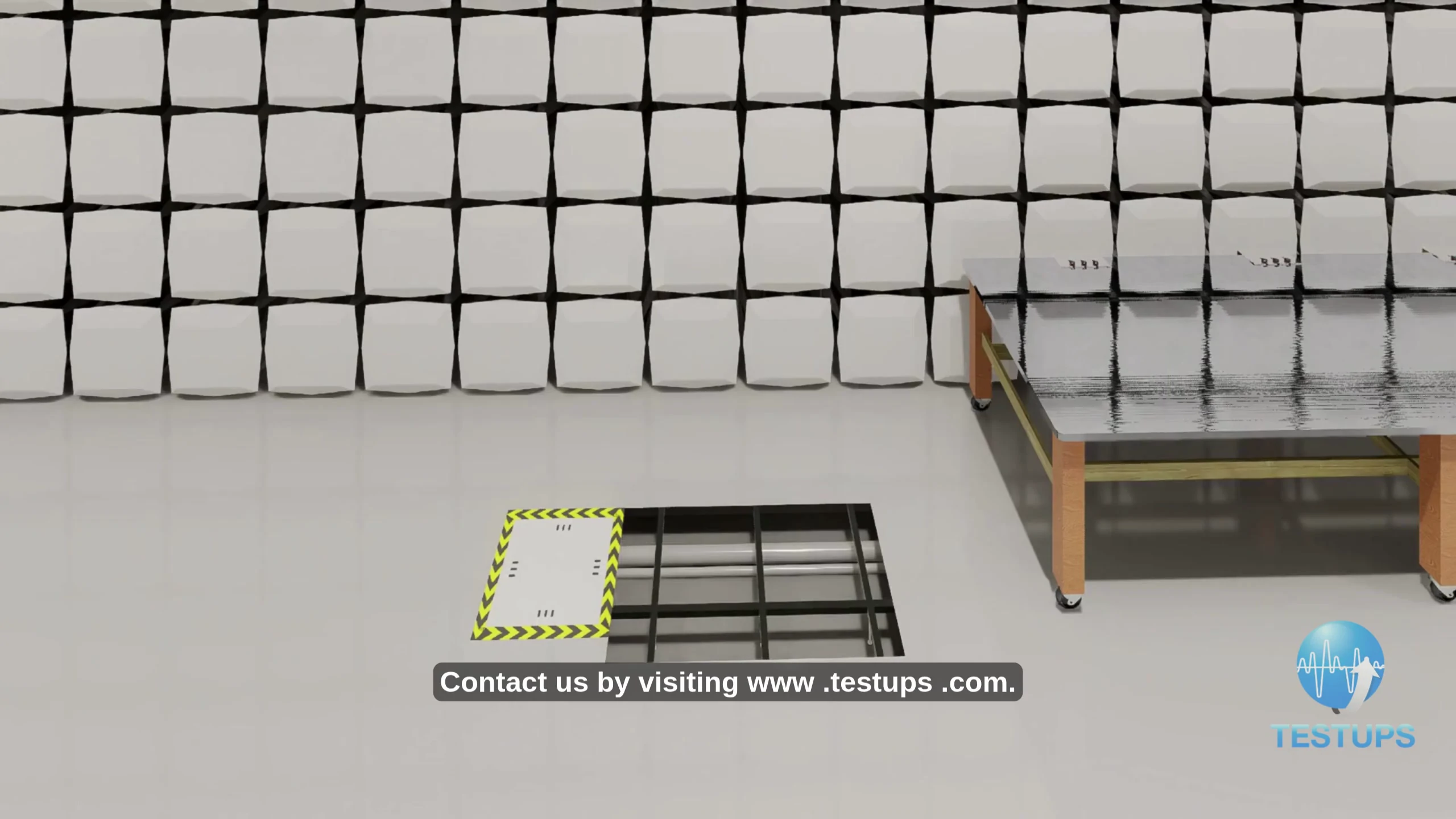
- Shielded enclosure design — modular galvanised steel panels with double knife-edge gasket doors, achieving > 100 dB shielding effectiveness 10 kHz – 18 GHz
- RF absorber treatment — hybrid ferrite + pyramidal absorbers engineered for the standards-required quiet zone, validated by NSA (Normalised Site Attenuation) measurement
- Vehicle handling — chassis dynamometer or roller-bench installation with shielded penetrations, rotating turntable, exhaust extraction, conditioned air supply
- Antenna mast and positioner — calibrated remote-controlled mast covering CISPR 25 / R10 measurement geometries
- Instrumentation room — adjacent shielded control room with RF amplifiers, signal generators, EMI receivers, transient generators, ESD guns, vehicle simulators
- Ancillary systems — climate control (chamber and instrumentation room), fire detection, vehicle access ramps, cable trays for high-voltage and CAN / Ethernet bus harnesses
- Calibration and accreditation support — NSA mapping, field uniformity certification, documentation pack for ISO/IEC 17025 audit
- Project delivery — site survey, civil works coordination, factory acceptance test (FAT), site acceptance test (SAT), operator training, lifecycle service contract
Frequently asked questions
What is a vehicle EMC anechoic chamber?
A vehicle EMC anechoic chamber is a fully RF-shielded room lined with RF absorbers and sized to accommodate a whole vehicle — passenger car, motorcycle, bus, or truck — together with the antennas, receivers, and amplifiers needed to perform electromagnetic compatibility tests. The shielding (typically > 100 dB attenuation) blocks ambient radio signals from contaminating the measurement; the absorbers eliminate internal reflections so the chamber behaves like a free-space environment for the standards-specified frequency range (usually 9 kHz to 18 GHz, often extended to 40 GHz).
What is the difference between a Regular and a Long Vehicle EMC Chamber?
A Regular Vehicle EMC Chamber is sized for M1 passenger cars, N1 light commercial vehicles (vans, pickups), and L-category two- and three-wheelers — typically vehicles up to ~6 m long. A Long Vehicle EMC Chamber is engineered for M3 buses, N2 / N3 heavy trucks, O3 / O4 trailers, articulated buses, and T-category agricultural tractors — vehicles 12 m to 20+ m long. The Long variant uses a larger footprint, taller ceiling, oversized roller dynamometer or sliding turntable, and reinforced absorber treatment on the long walls.
What EMC standards apply to vehicles in Europe and the UN ECE region?
The primary regulatory reference is UN ECE Regulation No. 10 (Revision 7), the electromagnetic compatibility component of vehicle type-approval recognised by ~60 contracting parties including the EU, UK, Türkiye, Japan, Korea, and Russia. R10 references vehicle-level test methods from ISO 11451 (broadband and narrowband off-vehicle radiation, on-board transmitter simulation, BCI), component-level methods from ISO 11452, CISPR 12 (radio disturbance for protection of off-board receivers), CISPR 25 (on-board receivers), CISPR 36 (electric and hybrid electric vehicles), ISO 7637 (transient conducted disturbances) and ISO 10605 (ESD). The EU EMC Directive 2014/30/EU and Type-Approval Regulation (EU) 2018/858 are the legal framework that adopts R10.
What compliance levels does TESTUPS support?
TESTUPS chambers are configured for the full compliance ladder: (1) pre-compliance EMC testing during product development for risk reduction and design iteration; (2) partial testing of specific tests or sub-systems (e.g. CISPR 25 component-level only, or RI immunity only); and (3) full type-approval testing per UN ECE R10 / 2014/30/EU. The same chamber can serve all three depending on instrumentation, calibration regime, and operator competence.
Who uses vehicle EMC chambers?
Vehicle manufacturers (OEMs) for in-house pre-compliance and full type-approval testing; Tier-1 and Tier-2 component suppliers for sub-system qualification; independent test laboratories (ITLs) accredited under ISO/IEC 17025 offering testing services to multiple clients; and university and government research institutes for automotive electromagnetic research, including EV / HEV high-voltage emissions characterisation under CISPR 36 and connectivity testing.
Specifying your vehicle EMC chamber
Tell us the heaviest and longest vehicle the chamber must accept, the standards you intend to test against (UN ECE R10, CISPR 25, ISO 11451, OEM spec), and whether your target is pre-compliance, partial, or full type-approval. We respond with a tailored chamber layout, dynamometer choice, instrumentation pack, lead time, and quotation — typically within five business days.